Solar Decathlon in Wuppertal ends with record attendance
(copy 1)
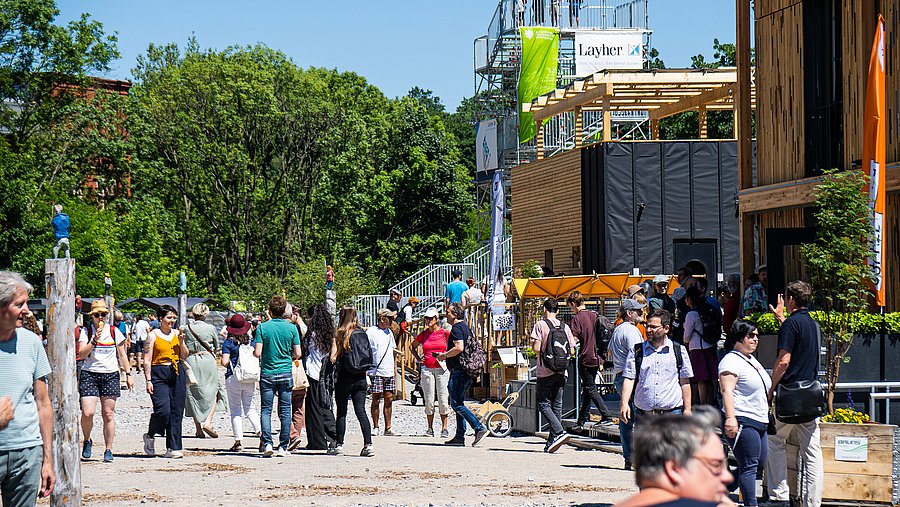
At the Solar Decathlon in Wuppertal from 10 to 26 June 2022, 16 university teams from ten countries demonstrated how to close gaps between buildings, add storeys to buildings or renovate aging buildings in a climate-friendly and cost-effective way. The competition profile for building on existing structures, developed by the Bergische Universität Wuppertal as the organiser, was a great success.
More than 115,000 international visitors came to the Solar Campus in Wuppertal on twelve days of events. "The young students with their positive charisma were fantastic. Wuppertal and our university as host were able to show their best side. And the sun shone on us too. We are very proud to have made concrete measures for saving the climate tangible with the Solar Decathlon," says Prof. Lambert T. Koch, Rector of the University of Wuppertal. The representatives of the Federal Ministry of Economics and Climate Protection (BMWK) as the funding body were also enthusiastic.
The integration of solar systems into building technology and architecture was shown at a particularly high level. Many teams focused on systems that combine solar heat and power generation in one component (PVT), or showed innovative systems in variations of technology, dimensions, shapes and colours. In multi-storey residential construction, this also involves systems on façades, as the area on the roof is often insufficient.
Massive energy savings and the use of solar energy on the building are the keys to doing without gas and oil. Almost all buildings achieved a positive energy balance during the competition period, i.e. most of them generated significantly more electricity than they needed. "In combination with battery storage and automation technology, the teams used on average half of the solar power generated in the house itself. That is significantly more than is usual today," explains the technical director of the competition, Prof. Karsten Voss, from the University of Wuppertal.
For the first time, the competition also tested how flexibly the buildings react to the demands of the electricity grid in terms of consumption and feed-in. With special test procedures, the teams had to prove on site that their buildings could be heated with little heat in winter, despite summer temperatures.
Another important theme at the Solar Decathlon was a building design that promotes recycling-friendly construction and thus improves the circular economy in construction. The reuse of materials or entire building components and the use of recycled materials were readable with their own aesthetics. And: With compact floor plans, the houses showed how living on less private space can be attractive and how communal areas complement the space programme.
For all buildings, the competition results, extensive specialist information and an interactive 3D tour are available on the event website. From autumn 2022, eight houses can also be visited as part of the follow-up project Living Lab NRW in Wuppertal.
Fotodownload
Contact:
Scientific contact:
Prof. Dr.-Ing. Karsten Voss
Faculty of Architecture and Civil Engineering, University of Wuppertal
E-Mail: kvoss[at]uni-wuppertal.de
Phone: +49 202 439 4094
Enquiry notes:
Dr. Marion Wittfeld
Head of Communications Solar Decathlon Europe 21/
E-Mail: wittfeld@uni-wuppertal.de
Phone: +49 1515 7405105